Skip to content
How Much Should You Charge for a Small Business Website?

How Much Should You Charge for a Small Business Website?

Published on November 5, 2026


If you're looking to sell websites to local businesses, one of the first questions you'll face is how much to charge. Traditional web design agencies and freelancers can charge thousands of dollars to design and build a small business website, putting professional web design out of reach for some small business owners. For local businesses operating on tight budgets, those upfront costs can be a major obstacle.

That's where you have an opportunity to stand out. By offering professional websites at more affordable prices, you can give small businesses an accessible alternative to expensive web design services while building a profitable business of your own. You don't have to be the most expensive provider to succeed. Instead, focus on delivering value, making the process simple, and providing reliable ongoing support at a price that works for your clients.

The key is finding a pricing structure that keeps you affordable and competitive while allowing you to build a profitable, sustainable business.

As a starting point, consider charging $500 to $1,500 for website setup and $50 to $100 per month for ongoing website services. Your exact pricing will depend on the scope of each project, the services you provide, your operating costs, and the needs of your target market. This approach allows you to offer an attractive alternative to higher-priced competitors while earning revenue from both the initial website build and the ongoing relationship with each client.

In this guide, we'll explore how to price small business websites, structure setup fees, create monthly service plans, and use additional services to increase revenue. Whether you're starting a website reseller business or looking to grow an existing one, these strategies can help you attract local business clients, compete on affordability, and price your services with confidence.


How Much Does a Small Business Website Cost?


The cost of a small business website could depends on how much customization is required, and what services are included.

Traditional web design agencies may offer extensive custom design, development, and consulting services, which can result in higher project costs. Freelancers, DIY website builders, and website resellers offer different approaches, each with its own pricing structure.

For many small businesses, the challenge isn't simply finding someone to build a website. It's finding a solution that fits their budget without sacrificing the professional online presence they need.


As a website reseller, you have the flexibility to set your own prices based on your target market, business goals, and the services you provide. The pricing ranges in this guide are suggested starting points to help you remain affordable and competitive while building a profitable business. You can adjust your setup fees and monthly rates to fit your needs, your clients' budgets, and the value you offer.
 

Typical Website Setup Fees


A practical starting range for your website setup fee could be somewhere between $500 to $1,500.

Within this range, you can create packages for businesses with different needs and budgets. A straightforward website with a handful of pages may fit the lower end, while a project involving more pages, content assistance, or additional functionality may justify a higher fee.

For example, you might structure your packages as follows:


• Starter website: $500–$699 for a straightforward website with essential business information and contact details.
• Standard website: $700–$999 for a more comprehensive website with additional service pages and content organization.
• Premium website: $1,000–$1,500 for a larger or more involved project with expanded setup services and additional functionality. 

These are suggested package prices rather than universal market rates. Your pricing should reflect your actual deliverables, costs, and the level of support you provide.
 

How Much Should You Charge Per Month?


In addition to your setup fee, consider charging $50 to $100 per month for ongoing website services.

Depending on your platform and service agreement, monthly fees may cover hosting, SSL certificates, routine maintenance, technical support, and a defined amount of website updates.

This model benefits both you and your clients. Business owners can spread their website expenses over time, while you can build a recurring revenue stream instead of relying entirely on new projects.

Be sure to explain what the monthly fee includes. Larger redesigns, additional pages, extensive content changes, and specialized marketing services may need to be priced separately.


Why Your Pricing Can Give You a Competitive Advantage


Your competitive advantage isn't simply charging less than another provider. It's offering a compelling combination of affordability, convenience, and ongoing support.

For example, a business owner comparing a costly custom website proposal with your clearly priced website package may appreciate knowing exactly what the initial investment will be and what ongoing costs to expect.

Rather than competing exclusively on price, emphasize the overall value of your service and the convenience of having a dependable provider to contact when website assistance is needed.


What Factors Should Determine Your Website Pricing?


Even when affordability is your primary selling point, you need to make sure each website is worth the time and money required to deliver it.

Before preparing a quote, consider the following factors.


Website Size and Complexity


A small business might need only a homepage, about page, services page, and contact page. Another business may need separate pages for multiple services, locations, staff members, or specialized features.

Larger projects generally require more setup, content organization, testing, and revisions.

Define what's included in each package so clients understand what they're purchasing. If a project falls outside your standard scope, explain the additional cost before beginning the work.


Your Operating Costs and Time


Your setup fee needs to account for more than the time spent putting a website together.

Consider the time involved in:

• Finding and contacting potential clients.
• Conducting consultations and preparing proposals.
• Gathering content, photos, and business information.
• Setting up the website and reviewing the finished result.
• Making revisions and providing client support.

You should also account for platform fees, software subscriptions, payment processing, and other operating expenses.

A website that generates $600 in revenue isn't necessarily profitable if it requires excessive labor or ongoing support.


Your Target Market and Local Competition


Research the providers serving your target industries and geographic area. Compare their services, pricing structures, support arrangements, and overall positioning.

Some providers may emphasize extensive customization and premium service. Others may compete on speed, affordability, or standardized packages.

You can stand out by offering a professional, well-organized website solution at a price that makes sense for small business owners.

Avoid assuming every agency charges the same amount or that every prospect prioritizes the lowest price. Your research should help you understand the alternatives your customers actually face.


The Value You Provide


Small business owners often want more than a website. They want a convenient way to establish their online presence without having to manage every technical detail themselves.

Your service may provide value through a streamlined setup process, a professional presentation of their business, accessible support, and predictable monthly costs.

Communicate those benefits clearly. A more affordable website package becomes much more compelling when prospects understand what's included and how it addresses their needs.

For more guidance, explore what small businesses look for in a web designer.


How to Structure Your Website Setup Fees


One of the best ways to simplify selling websites is to offer a few clearly defined packages.

Standardized packages make it easier to explain your pricing, prepare proposals, and deliver websites consistently. They also help prospects compare options without becoming overwhelmed by technical details.


Offer a Starter Website Package


A starter package priced between $500 and $699 can appeal to small businesses that need a professional website with essential information.

Depending on your platform and service model, the package might include:

• A defined number of website pages.
• Business contact information.
• A description of core services.
• A contact form.
• Basic website configuration.
• Mobile-friendly presentation.

Keep the scope clear and avoid including unlimited revisions or extensive custom work in a lower-priced package.

Your objective is to offer an accessible entry point while ensuring the project remains profitable.


Create a Standard Website Package


A standard package priced between $700 and $999 can serve businesses that need a more comprehensive online presence.

You might include additional service pages, help organizing existing content, expanded contact options, and basic on-page SEO configuration.

This package can be your primary offering because it provides a middle ground between a basic website and a more expensive, customized project.

Focus on the features and services your target customers value most.


Position a Premium Website Package


A premium package priced between $1,000 and $1,500 can accommodate businesses with more extensive requirements.

Depending on what you can deliver, this may include additional pages, expanded content assistance, specialized forms, or more involved setup and configuration.

Be specific about the benefits of upgrading. A premium package should offer meaningful additional value rather than simply charging more for the same service.


Alternative Pricing Ideas


Waiving the setup fee can be an effective way to attract businesses that are hesitant to make a large upfront investment.

In exchange, you could charge a higher monthly fee and require a clearly defined commitment period, subject to your agreement terms.

For example, consider two pricing models:

• Traditional pricing: $999 setup fee plus $79 per month.
• Lower upfront cost: $0 setup fee plus $99 per month for 12 months.The traditional option generates $1,947 in first-year revenue, while the second generates $1,188 over the 12-month commitment.

The lower-upfront-cost option may appeal to certain prospects, but it also means you collect less revenue during the first year. You should evaluate your costs, cash flow, contract terms, and client retention before deciding which approach to use.

A $0 setup fee isn't automatically more profitable. It is a pricing strategy that should be used when the numbers make sense for your business.


Why Monthly Website Fees Create Recurring Revenue


One of the most attractive aspects of a website reseller business is the opportunity to earn recurring revenue.

Rather than depending entirely on new website projects, you can develop a portfolio of clients who pay monthly for ongoing website services.


Decide What Your Monthly Website Plan Includes


Your monthly service plan should explain exactly what clients receive.
Depending on your platform and agreement, you might include:

• Website hosting.
• SSL certificates and supported security features.
• Routine maintenance.
• Basic website support.
• A defined amount of minor website updates.

For example, you could include up to 30 minutes of routine content updates per month. Larger changes, new pages, or specialized functionality would be quoted separately.

Clear limits help clients understand the service while preventing your monthly plan from becoming an unlimited support commitment.


Choose a Competitive Monthly Price


A monthly fee between $50 and $100 gives you room to offer different levels of service.

A $50 plan could provide essential website services and limited support. A $75 plan might include a greater amount of routine assistance, while a $100 plan could provide a more comprehensive support offering.

These are illustrative structures. Make sure the services included at each price level match your operating costs and the amount of work you can reasonably provide.

The goal is to give small businesses predictable costs while building a sustainable revenue model for your business.


See How Recurring Revenue Adds Up


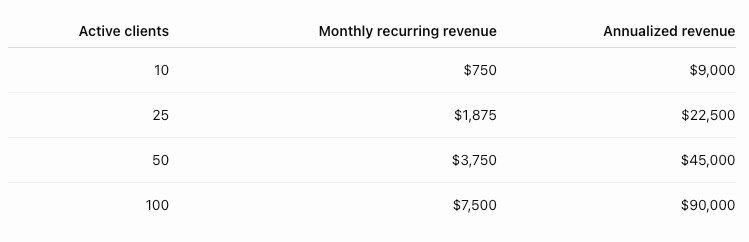
Consider how much monthly revenue you could generate if your clients paid an average of $75 per month.
 
Screenshot 2026 11 05 at 7.10.09 am
These figures are illustrative revenue calculations before expenses, taxes, discounts, and client cancellations. They are not estimates of net profit.

The example demonstrates how recurring service fees can become a meaningful part of your business as your client base grows.


Focus on Retaining Clients


Acquiring a new client requires time and effort. Retaining satisfied clients can help preserve the recurring revenue you've already built.

Respond to support requests within your stated service expectations, communicate clearly about updates, and make it easy for clients to understand what their monthly plans include.

You can also look for opportunities to help clients as their businesses change. Additional services should be relevant to their needs rather than unnecessary upsells.


Small Business Website Pricing Examples


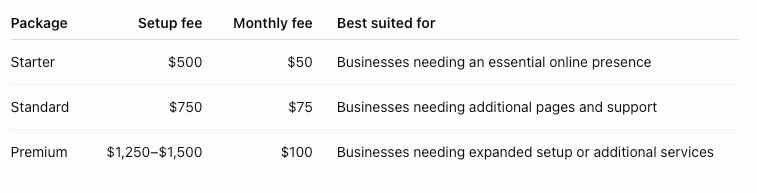
The following examples illustrate how you might combine setup fees and monthly services into a simple pricing structure.

 
Screenshot 2026 11 05 at 7.18.20 am
These are sample prices, not verified market averages. You should adjust the packages to match your costs, target audience, and service inclusions.
 

Example: Selling a Website to a Local Landscaping Company


Imagine you're approaching a landscaping company with an outdated website. The business wants a more professional online presence but doesn't want to invest in an expensive custom project.

You offer a standard package that includes a homepage, services page, about section, contact page, and basic website configuration.

Your pricing is:

• Setup fee: $750.
• Monthly service fee: $75.
• First-year monthly fees: $75 × 12 = $900.
• Total first-year revenue: $1,650.

If you sign 10 clients on the same terms and each pays for the full year, the combined first-year revenue would be $16,500.

This example illustrates the value of combining setup revenue with monthly service fees. Your actual profit will depend on platform costs, labor, support requirements, and other business expenses.


Compare Your Price With Alternative Providers


When prospects compare your services with traditional agencies, help them understand the differences in scope and pricing.

For example, if a prospect receives a custom agency proposal costing several thousand dollars, your $750 setup package may be an attractive alternative if it meets the business's requirements.

However, make sure you're comparing equivalent deliverables. A custom-built website with advanced functionality isn't necessarily the same product as a standardized website package.

Your goal is to offer the right solution at a competitive price, not to promise every feature of a custom agency project for a fraction of the cost.


How to Sell Websites to Local Businesses at the Right Price


A strong pricing strategy works best when paired with a consistent process for finding and converting prospects.


Identify Businesses That Could Benefit From a Website


Start with local businesses that have outdated websites, limited online information, or no dedicated website.

Potential prospects include plumbers, electricians, landscapers, cleaning companies, contractors, auto repair shops, and independent professional service providers.

Look for opportunities to improve how a business presents its services, communicates its contact information, and makes it easier for potential customers to get in touch.

Approach prospects professionally and focus on their business needs rather than criticizing their existing websites.


Position Yourself as an Affordable Alternative


Your pricing can be a major advantage when speaking with small business owners who have limited budgets.

Explain that you offer a more accessible way to establish a professional online presence, with clearly defined setup fees and predictable monthly costs.

Rather than emphasizing that your service is simply cheaper, explain how your process works, what the client receives, and how you'll support them after launch.

For example, you might say:

Our website packages are designed to help small businesses get a professional online presence without the large upfront investment that some custom web design projects require. We provide straightforward pricing and ongoing support, so you know what to expect.

This positions affordability as part of your overall value proposition.


Present Two or Three Pricing Options


Offering multiple packages gives clients flexibility without forcing you to negotiate every project individually.

Present a starter option for basic needs, a standard package for a more complete website, and a premium option for businesses that need additional services.

Explain the setup fee, monthly charge, included deliverables, and any extra costs.

When prospects understand the differences, they can choose the option that best fits their needs and budget.


Handle Price Objections Confidently


If a prospect says your website is too expensive, ask what they're comparing it with and which part of the investment concerns them.

They might be comparing your service with a DIY website builder, another freelancer, or an agency proposal.

Explain the value of your service and the support included. If the prospect has a limited budget, consider recommending a smaller package rather than discounting the same scope of work.

Being affordable doesn't mean accepting every price a prospect requests. It means creating an offer that delivers value while allowing your business to remain profitable.


Develop a Repeatable Sales Process


A straightforward sales process can help you acquire clients more consistently.

1. Identify suitable local business prospects.
2. Review their existing online presence.
3. Contact the business with a relevant, professional message.
4. Learn about its needs and budget.
5. Recommend the appropriate package. 6. Explain the setup fee, monthly plan, and scope of work.
7. Follow up professionally and onboard new clients.

Over time, refine the process based on the types of businesses that respond best and the packages that are easiest to sell and deliver.

Learn more about the SiteSwan reseller opportunity if you're exploring ways to build a business around selling websites to local companies.


Increase Revenue With Website Add-On Services


Offering affordable websites doesn't mean your business has to rely exclusively on setup fees and monthly website plans.

Once you've established a client relationship, you may be able to provide additional services that address the business's evolving needs.


Offer Search Engine Optimization Services


Local businesses may need help improving their website content, targeting relevant search terms, and making their services easier to discover.

Potential services include keyword research, on-page optimization, local SEO strategy, and ongoing content creation.

Price SEO separately according to the work involved. Basic website setup does not guarantee search rankings, and any claims about results should reflect what you can reasonably substantiate.


Provide Reputation Management


Online reviews can influence how prospective customers evaluate local businesses.

Depending on your capabilities, you could offer review monitoring, assistance with responding to reviews, and guidance on encouraging customers to leave honest feedback.

Explore reputation management services to learn more about this complementary offering.


Offer Content and Website Updates


Businesses regularly need to update service descriptions, operating hours, promotions, and other information.

You can offer additional website updates or content creation for clients whose needs exceed the work included in their standard monthly plan.

Blog writing, new service pages, and seasonal landing pages can also become separate revenue opportunities.


Expand Into Other Digital Marketing Services


Social media management and complementary marketing services may help you increase the value of your client relationships.

Start with services you can deliver consistently or partner with qualified providers when appropriate.

For additional ideas, see 10 add-on services you can offer to web design clients to boost your bottom line.


Common Website Pricing Mistakes to Avoid


Even an attractive pricing model can become unprofitable if you don't set clear expectations.

1. Competing only on price. Affordability is a selling point, but clients should also understand the value, convenience, and support they receive.

2. Underpricing your work. Make sure your setup fees cover the time, platform costs, and resources needed to deliver the website.

3. Offering unlimited updates. Define the support included in monthly plans and charge separately for work outside the agreed scope.

4. Failing to explain recurring fees. Clients should know what their monthly payments cover and which services cost extra.

5. Ignoring operating expenses. Revenue is not profit. Account for software, platform fees, payment processing, sales activities, and client support.

6. Overpromising compared with custom agencies. Explain the capabilities and limitations of your packages honestly. Your competitive advantage is providing the right solution at an accessible price, not pretending every website project is identical.

7. Never reviewing your prices. Revisit your packages as your costs, experience, and client expectations change.

Clear pricing, defined deliverables, and consistent service help you protect profitability while maintaining a competitive offer.


Build a Profitable Website Reseller Business


So, how much should you charge for a small business website? A practical starting point is $500 to $1,500 for setup and $50 to $100 per month for ongoing website services.

These prices can help position your business as an affordable alternative to more expensive web design options while creating opportunities for recurring revenue.

To succeed, focus on more than offering a lower price. Develop clear website packages, communicate the value of your service, set boundaries around ongoing support, and make the buying process simple for small business owners.

As your client base grows, recurring monthly fees can provide a more predictable revenue stream. You can also expand your offerings with relevant services such as SEO, reputation management, and content updates.

You don't necessarily need to build every website from scratch or operate a traditional web design agency to serve local businesses. With an efficient platform, a repeatable sales process, and thoughtful pricing, you can build a business that helps small companies establish a professional online presence without taking on the cost of an extensive custom project.


Ready to start selling websites to local businesses?

Explore the SiteSwan reseller opportunity to learn how you can build your own website reseller business, offer affordable website solutions, and develop recurring revenue from ongoing client relationships.


We'd love to hear from you!

Share your comments or questions using the form below.